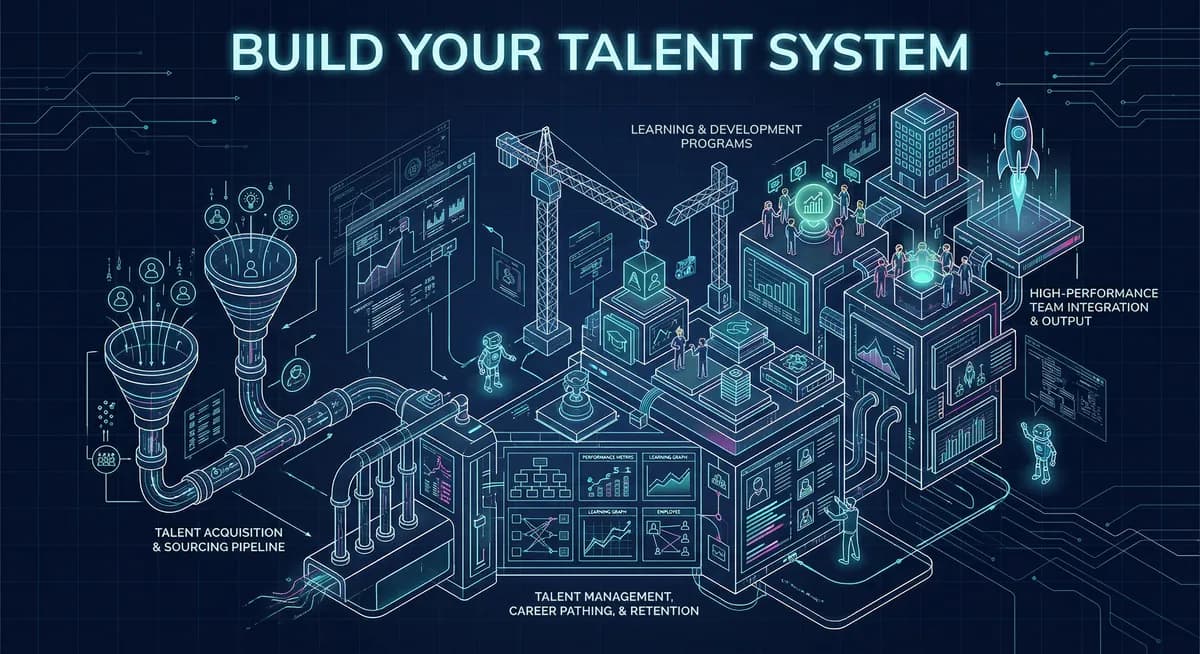
The Real Problem Isn't Talent Scarcity
In Vietnam, 65% of employees plan to change jobs within six months. Over 75% of employers can't find the talent they need. This isn't a shortage. It's a system design problem.
Serial entrepreneur Ray Chou, who built 19 companies, led a session for Leadership in the AI Era that exposed the truth: loyalty is not something you screen for. It's the result of the environment leaders create.
The Four Stages of Your Employee Lifecycle
High-performing companies treat the entire employee journey as one integrated system:
Find -> Hire -> Retain -> Exit Each stage feeds the next. You can't excel at retention if you hire wrong. You can't find talent if you're invisible. You can't exit professionally if you didn't build trust. They're interconnected.
Stage 1: Find - Build Visibility
74% of candidates say company size doesn't matter. They want to see a legitimate, dynamic company. Your size isn't your weakness. Your invisibility is.
The talent you need is already looking; they just can't see you yet. Make your team visible. Show your culture. Let candidates see who you actually are and how you work.
Stage 2: Hire - Move from Instinct to Structure
This is your biggest lever.
Traditional interviews predict about 10% of job performance. Structured behavioral interviewing predicts 50% or better. That's a 5x improvement.
Stop hiring on gut feeling. Build a framework. Define the exact competencies that predict success in your roles. Ask consistent questions. Evaluate across multiple perspectives.
Apply AI to Remove Bias
AI helps by standardizing interview evaluation across multiple perspectives and catching patterns humans miss. Use:
Stage 3: Retain - Three Factors That Keep Your Best People
Loyalty comes from building the right environment.
Build Structure for Clarity
Clarity on expectations and career paths. People know what success looks like and how to get there. When people understand the path forward, they invest in it.
Create Culture of Belonging
The environment where people want to show up. Psychological safety, inclusivity, and trust. Culture isn't a mission statement. It's the day-to-day experience of working with your team.
Invest in Growth and Development
Continuous learning and development. 76% of Gen Z prioritize career growth above salary. Your team wants to improve. Give them the tools and space to do it.
Neglect one of these three, and you lose momentum. Get all three right, and you build teams that stay.
Stage 4: Exit - Design the Departure
How people leave matters. A thoughtful, professional exit maintains relationships and protects your reputation. Treat exit interviews as learning, not formality. The insights from departing employees are gold.
The AI Advantage
AI creates the biggest impact when it supports your entire leadership system, not just one step. The companies winning at talent are using AI for:
These tools remove guesswork and bias from every stage of the employee lifecycle.
The Results
This framework, tested across 19 companies, delivers measurable results.
When you treat your talent system as integrated, everything gets better. Finding becomes easier. Hiring becomes more predictable. Retention improves. Even departures become learning opportunities.
The framework works because it treats people as a system, not a series of isolated problems. Each stage feeds the next. Excellence at one stage makes the next stage easier.
Start with your biggest bottleneck. For most organizations, that's hiring. Build structure. Measure results. Then move to the next stage.