I have been building a version of this coach for years.
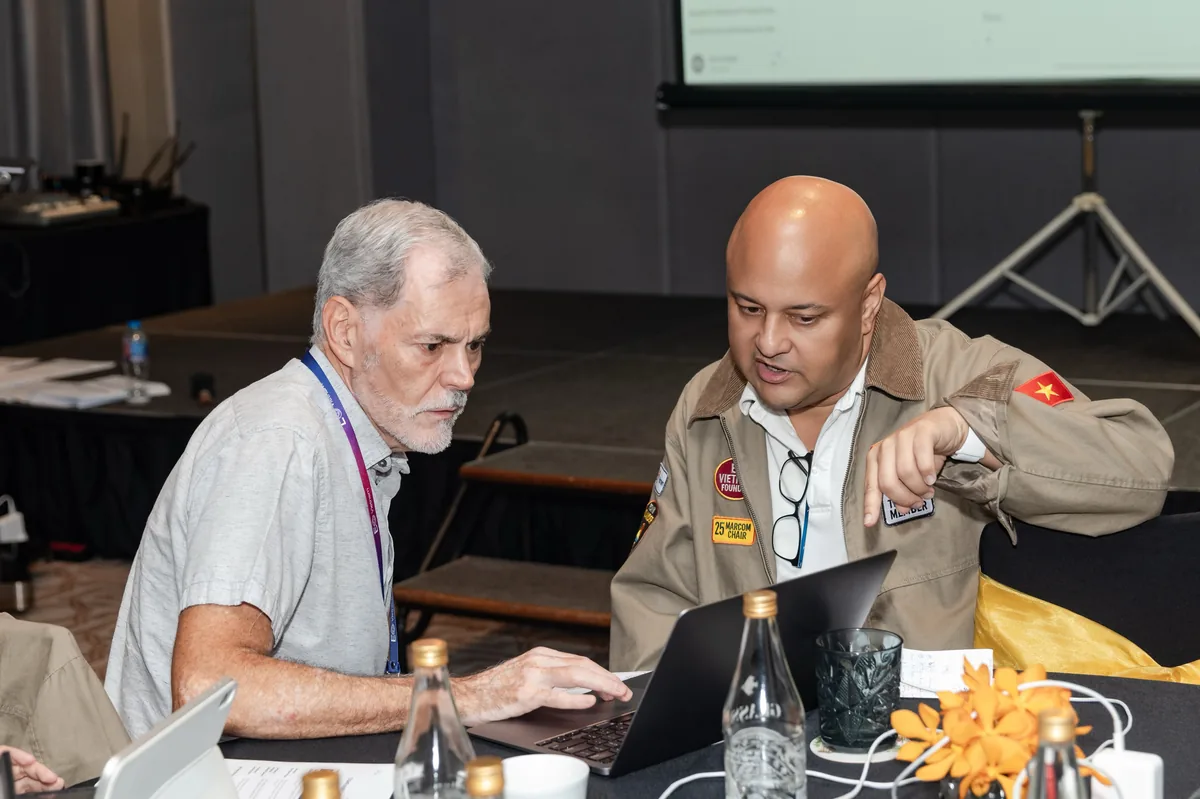
There has almost always been something running. A packaged tool with a limited routine. Automations I wired together by hand back in the old Make.com days, each one doing a single slice of the job. A folder called leadership-coach with my datasets in it. I teach a whole session for EO Vietnam and EO Perth on Leadership in the AI Era, built on concepts I teach with Dr. Brooks C. Holtom of Georgetown, on how to build an AI leadership coach for your team. I have always practiced what I teach. What I never had was a way to build it exactly the way I wanted.
This week I did, and the how matters. I did not write code. I directed Claude Code to assemble it: it read the teaching, wired the whole system together in Lark, and ran it on my real data. For the first time the tools did not fight me. I could build it the way the teaching actually describes and apply Dr. Holtom's framework in full, not a watered-down version. Start to finish, in a day.
Here is what we made, and the part I did not see coming.
Start with the way you already teach it
The first thing my AI did was not write code. It read the curriculum. All eight lessons of Leadership in the AI Era, the way we actually teach it to executives. The whole program rests on one idea: every lesson ends in a dataset, and the datasets compound into a coach. Lead Yourself gives you your brand, your emotional intelligence, your communication style. Lead Your Team gives you the lifecycle, the coaching profiles (an OCEAN personality read on each person, the Big Five), the OKRs. Stack them and you get an assistant that knows your people, not a generic chatbot.
I had built the first half years ago. My foundation folder was already my Series I datasets, carried over from earlier versions of this same coach. What the older tools could never do cleanly was the team layer, on my real five direct reports. That is the work that turns a framework into a system, and it is the part that finally clicked with Claude and Lark.
The spine: OKRs, a database, and a clean split
We tightened my 2026 company goals into real OKRs (Objectives and Key Results). Not a wish list. Objectives that point somewhere and key results that are measurable outcomes, not activities. We separated leading indicators from lagging ones, because the lagging numbers tell you that you lost two months too late. Paid keynote demand moves first. Revenue confirms it last.
Then we built the backbone in Lark. One Base, three tables: company OKRs, FAST goals, accountability log. People are not a table I maintain. People are the org directory we already have. No duplication.
The design decision I am proudest of is the split between two views of the same data.
There is my private coaching view. How each person is wired, the engagement root that is loose for them, the retention risk. That is mine. It never leaves my space.
And there is each person's own view, in our talent wiki. Their FAST goal, how it ladders up to a company objective, what they committed to, and a recap of every one of our conversations. That is theirs. They never see my read on them, only the work and the goals we share.
One source of truth. Two lenses. The coaching read stays private. The goals and the accountability are transparent, which is exactly what the FAST framework demands. (FAST goals are Frequent, Ambitious, Specific, and Transparent. Transparency is not a nice-to-have in the model. It is the point.)
One meeting, two outputs
The piece that makes this real is the recap engine. After a one-on-one, it pulls the transcript out of Lark and produces two things from the same conversation. For me, a private extraction: what they want, what is true, what we discussed, what they committed to, and the one signal of what is loose. For them, a clean recap of what we covered and what they took on. Same meeting, two audiences, automatically separated.
I tested it on a real conversation. It worked. It pulled my last one-on-one, wrote my coaching notes, and drafted the version my engineer sees. The thing I have been doing by hand for years, on a schedule.
Then it held up a mirror
Here is the part I did not plan for.
I asked it to rate my last one-on-one with each person on the Coach, Mentor, Direct mix. Coaching is asking questions so they grow. Mentoring is sharing your experience. Directing is just giving the answer. The research target for a strong leader is roughly eighty percent coaching, fifteen mentoring, five directing.
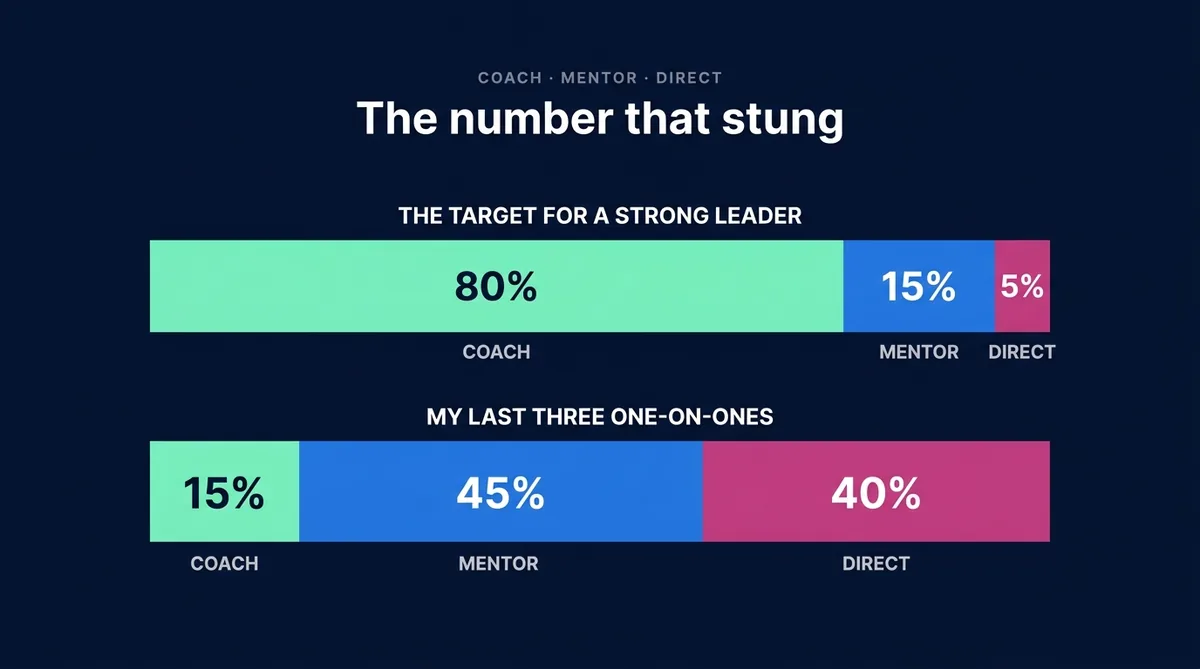
It read three of my actual transcripts and gave me the numbers. Across the three, I was running about fifteen percent coaching, forty-five mentoring, forty directing. Almost the exact inverse of where I should be. With one person who has been with me a long time, I was directing sixty percent of the time. I was telling, not asking.
The uncomfortable part is that my own leadership profile predicted it. It literally says I skip ahead to my answer and I over-direct. I wrote that about myself months ago. The system just held me to it with data instead of a feeling.
That is the whole point.
The one I built will tell me, before every cycle, when I am about to solve a problem I should be coaching someone through.
What runs without me now
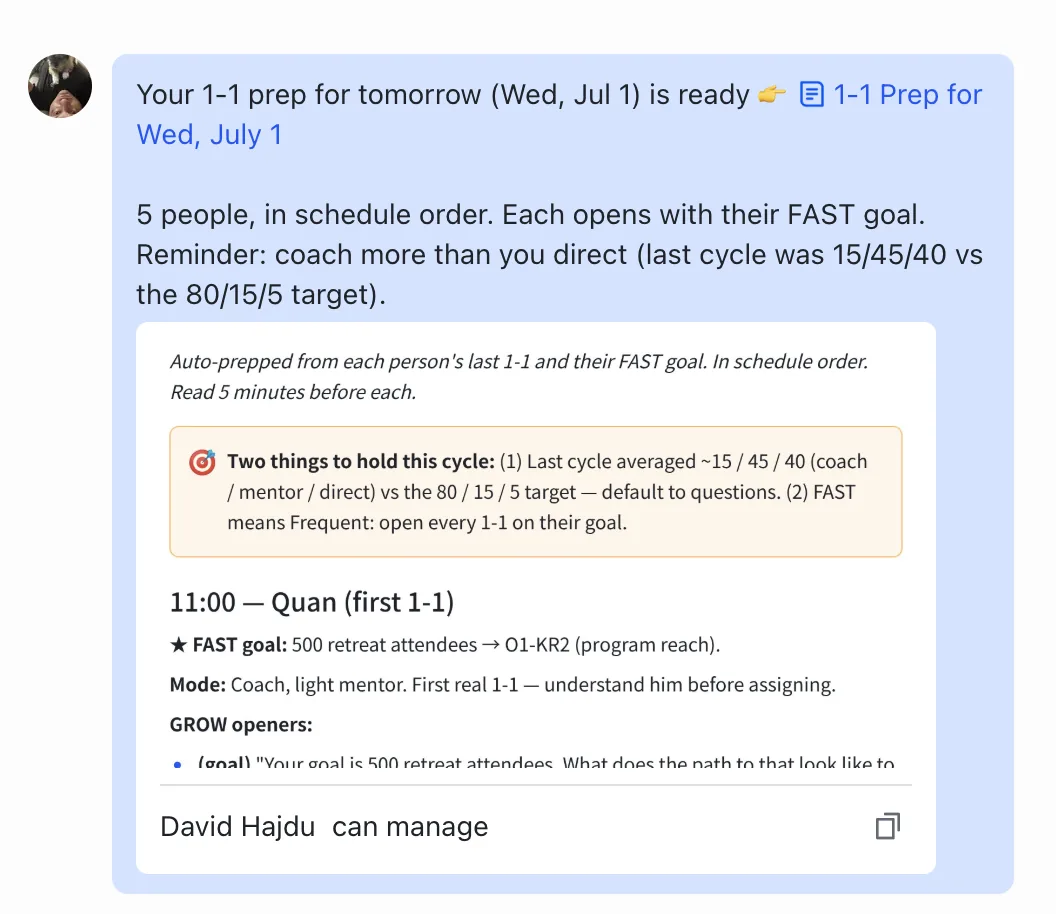
The rhythm is on a schedule. Before each cycle it preps me, structuring the questions with GROW (Goal, Reality, Options, Will) and drawing on the last conversation with each person to aim them at what is loose. After the meetings it writes the recaps. The day after, it follows up with each person on what they committed to. A coaching command center sits on top of it: who is overdue, who has no goal set yet, what my mode mix looks like over time.
Coaching mode mix
Ops lead
Coach hard, last ran 60% directPrivate, the coach
- 5 catalogue lines
- What's actually true
- The loose root
- Mode tag, for the mix
Shared, the person
- Plain-language recap
- What they committed to
- Their FAST goal
- Sent to them in Lark
I did not buy a tool. I designed a system, on my own data, that does the half of the work AI can do, so I can spend my time on the half it cannot: the actual conversation, the relationship, the judgment.
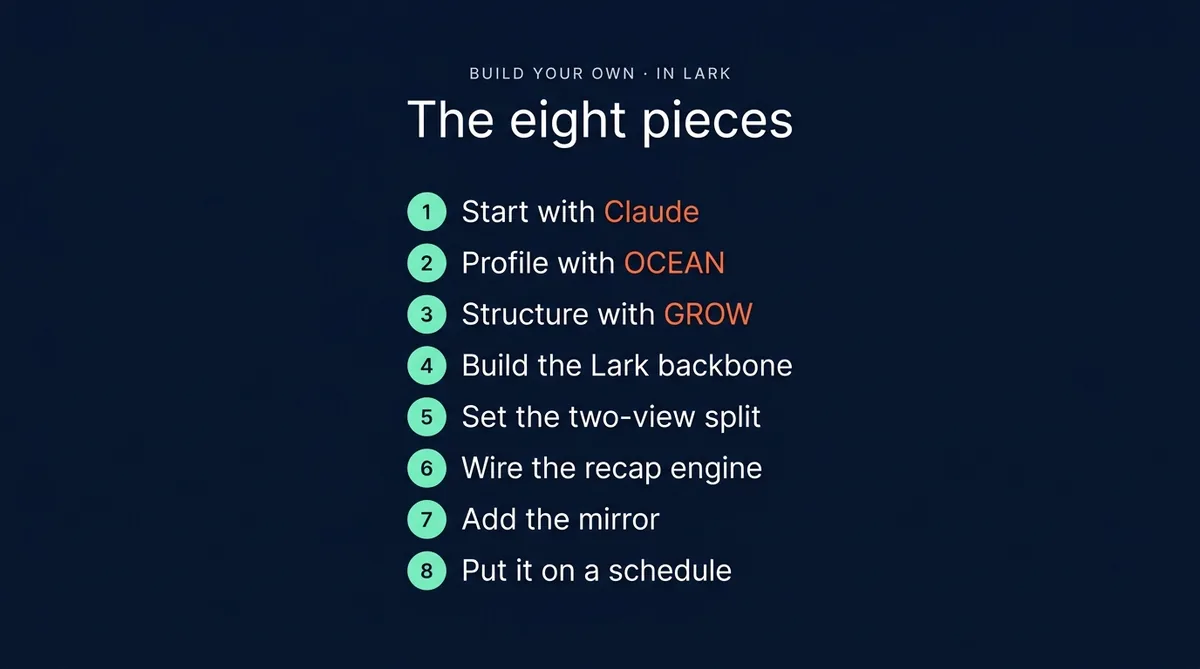
Build your own: the eight pieces
You do not need my curriculum to start. You need an AI that can actually reason over your world (I used Claude), your own data, and the honesty to act on what it shows you. Here is the shape, top to bottom.
- Start with Claude as the engine. The reasoning is the foundation, not the database.
- Profile each person with OCEAN. The Big Five read on how each person is wired.
- Structure every conversation with GROW. Goal, Reality, Options, Will.
- Build the backbone in Lark. One Base: company OKRs, FAST goals, an accountability log.
- Set the two-view split. Your private coaching read, their shared view.
- Wire the recap engine. One meeting, two outputs.
- Add the mirror. Score your Coach, Mentor, Direct mix against the target.
- Put it on a schedule. Prep before, recap after, follow up the day after.
That is the shape, and the frameworks are the hard part and the whole point. I wrote the whole build up step by step, every Lark command and every scope: the full AI Leadership Coach Assembly guide.

Not a prompt. A system
That is what leading AI looks like in practice. An AI leadership coach is not a prompt. It is a system. And if you build it honestly, it will coach you as hard as it coaches your team.
I am going to go run a real one-on-one now. This time I am going to ask more than I tell.
Read next: I Was the Coach in the Room. I Did Most of the Learning · How to Set Goals That Don't Fade · The Leadership Brand You Already Have