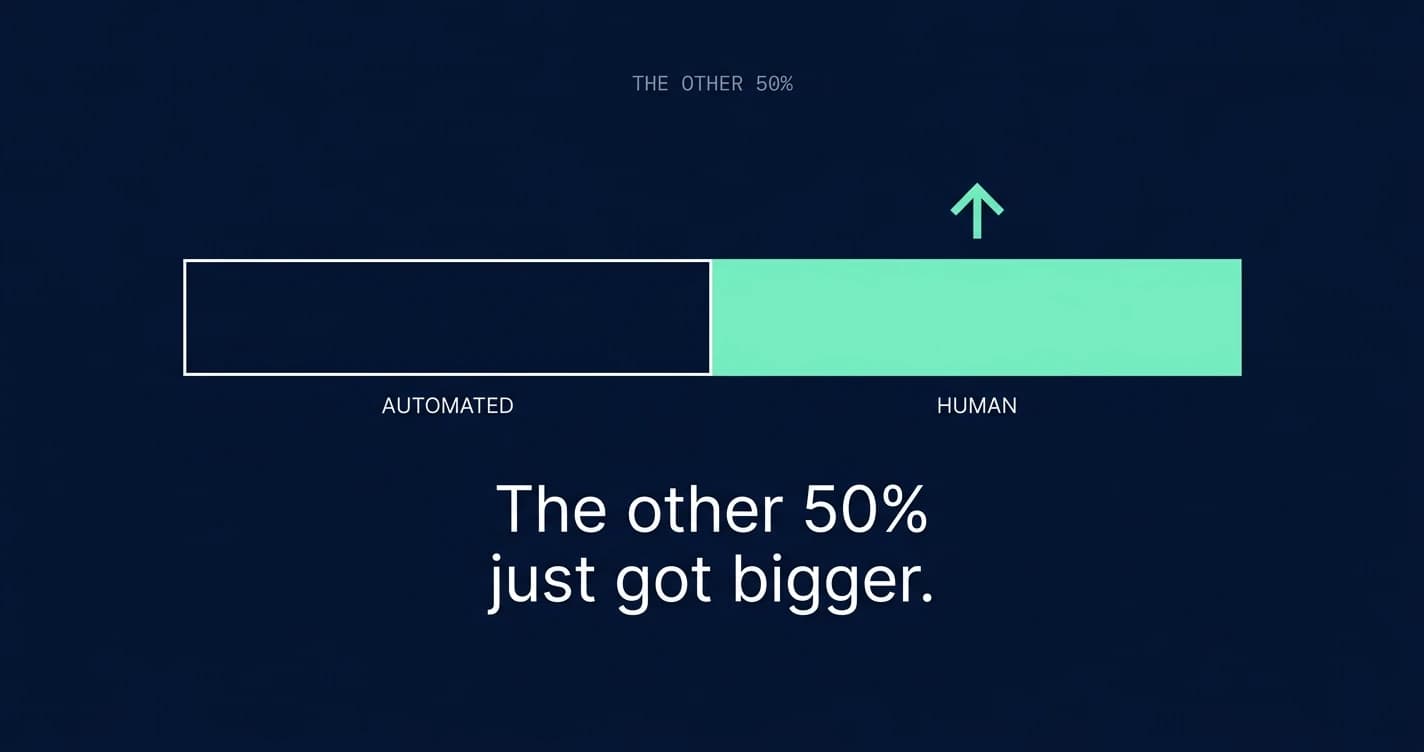
You started where I did. The assumption was in every room, said out loud or just sitting in the air: AI is coming for the work. Automate the task, remove the human, bank the savings. Notice what that assumption does to you when you really sit with it. Do you brace, or do you build? Most leaders I coach are quietly bracing, even the ones moving fast. They are waiting to find out which half of their job survives.
I want to show you why I think the half everyone is worried about is the half that grows.
My own evidence kept contradicting the story
Here is what I actually see, week to week. I spend most of my time now teaching people to build with AI. Retreats where non-technical founders ship a working application in two days. Sessions where leaders map their workflows to agents. A staffing business placing AI engineers into companies that are automating as fast as they can.
By every assumption I started with, this work should be shrinking. The better the models get, the less anyone should need me. Instead the demand keeps climbing.
I sat with that contradiction for two years without language for it. Then I read Dan Shipper's essay After Automation this week and finally had the words. Shipper runs Every, a company that automates everything it can, alpha tests every frontier model, and lives in Claude Code and Codex all day. If anyone should be watching human work disappear, it is him. His conclusion surprised even him. There is more human work to do than ever.
He did not give me the idea. The retreats gave me the idea. He gave me the mechanism, and the mechanism is worth understanding, because once you see it you stop bracing.
The engine that turns automation into more work
Here is how cheap AI creates work instead of removing it. Five steps, and each one causes the next.
1. Models commoditize yesterday's competence. They are trained on the residue of finished human work, so once-rare skills become cheap and available to anyone.
2. Cheap competence gets adopted fast. When the cost drops, supply spikes. Shipper points at OpenClaw, an open source agent project that logged 44,469 pull requests, more than 12,000 of them in roughly six weeks. Kubernetes, one of the most popular open source projects on earth, took all of 2022 to reach 5,200.
3. Abundance creates sameness. Everyone draws from the same models trained on the same corpus, so the default output converges. Shipper calls this slop, and his definition is sharp: slop is visible sameness, repeated.
4. Sameness creates demand for difference. People learn to smell slop fast, so the rare and valuable thing becomes work that fits this exact person, company, and moment.
5. Difference can only come from a human. The model knows what has been done. Only a present human is alive to what needs doing right now.
— Dan Shipper, After Automation
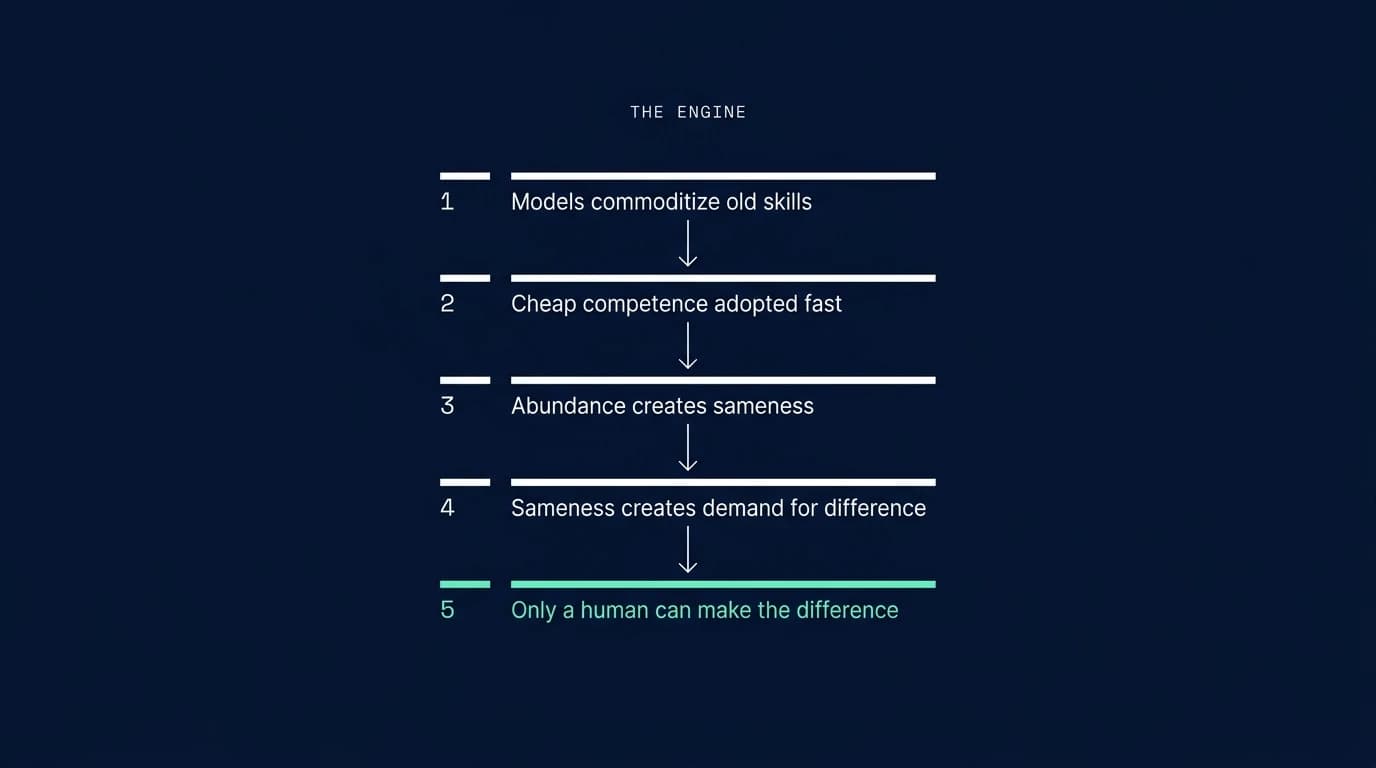
Read those three sentences again. They are his, and they are the whole argument compressed. Automating expert work does not replace experts. It multiplies the situations that need expert judgment. Every act of cheap production creates a new act of human review, direction, or differentiation downstream.
That is the other 50%, in someone else's words. And it explains the thing I could not square: the companies furthest along on automation are hiring more expert humans, not fewer.
The detail that hit closest to home
Ask yourself: if agents really replaced people, what would the most automated company in the world do with its staff?
Every tried to give each employee a personal agent. The agents went stale. People lost interest, stopped maintaining them, and the agents quietly degraded. So the company pulled back to agents that serve a team or the whole business, kept alive by a dedicated group of AI engineers they expect to need for the foreseeable future.
Agents are not appliances. They need maintenance, framing, and someone who owns whether they work. Shipper describes one PowerPoint automation that runs 24 skills and 18 scripts and costs $62 in tokens to produce a single deck. Even automating something mundane becomes a standing project with its own upkeep.
This is the clearest outside validation I have seen of the AI Officer role. The reason I embed AI engineers in the build retreats is the same reason Every keeps a standing team. The agent does not run itself. Someone has to own it.
You have to sit in the sandwich
Shipper borrows a phrase from his colleague Kieran: we are the bread on either end of the AI's work. You set the frame at the start, what are we trying to do and what counts as good. The AI collapses the task in the middle, it drafts, searches, codes, compares. Then you judge and extend at the end, is this good, where does it belong, what happens next.
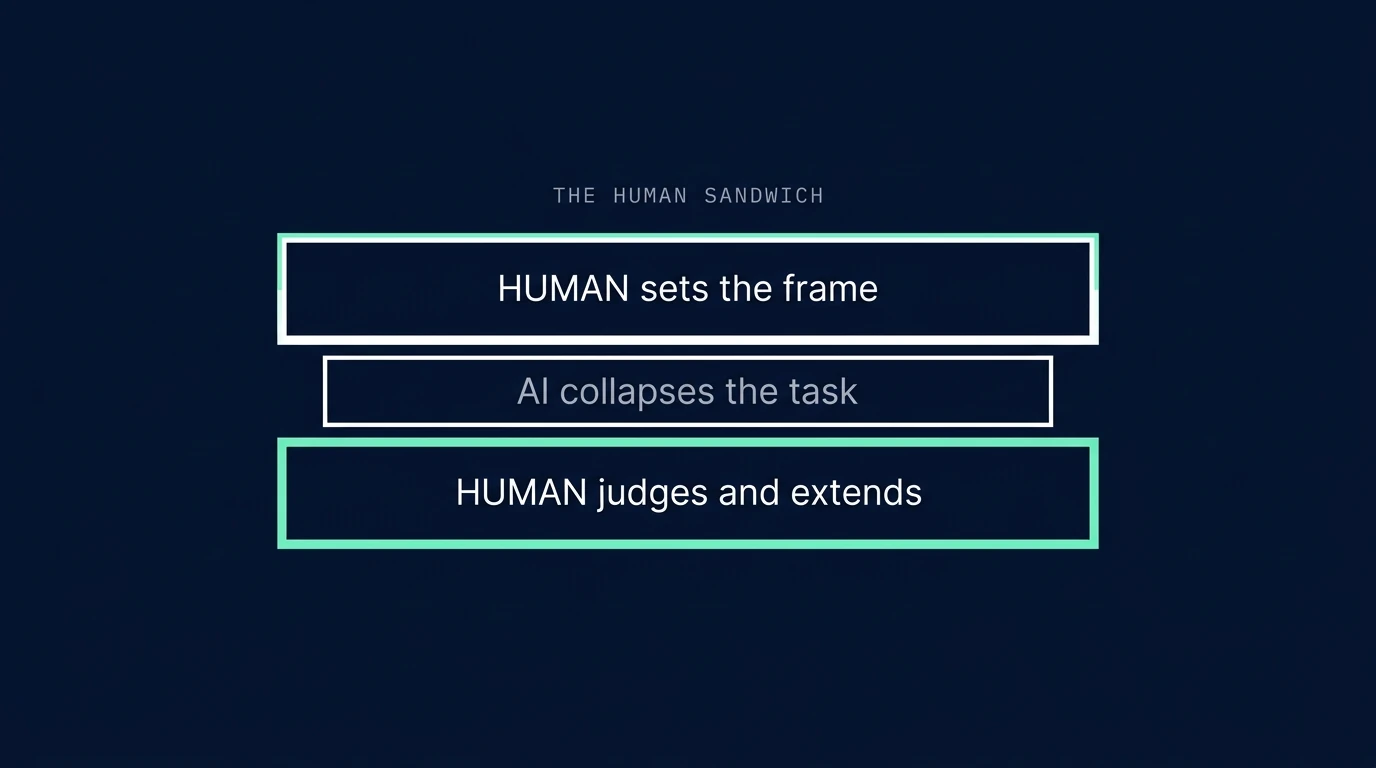
This is exactly the shape of what we put people inside at Infinite Leverage. Most of the talk pictures AI as an employee you delegate to and walk away from. The more important mode is the shared workspace, where you and the agents work the same problem at the same time. You cannot learn that by reading about it. You have to sit in the sandwich and feel where your judgment is load bearing. That feeling is the skill.
There is always a framer, and the framer is you
Here is the part that holds even if you believe AGI is close.
A benchmark only measures how well a model performs inside a frame that a human chose. Saturate the frame and a human redraws it. The cycle repeats. Even a strong AGI that can pick its own frames still optimizes toward a goal that a human set. There is always a framer. The framer is the leader.
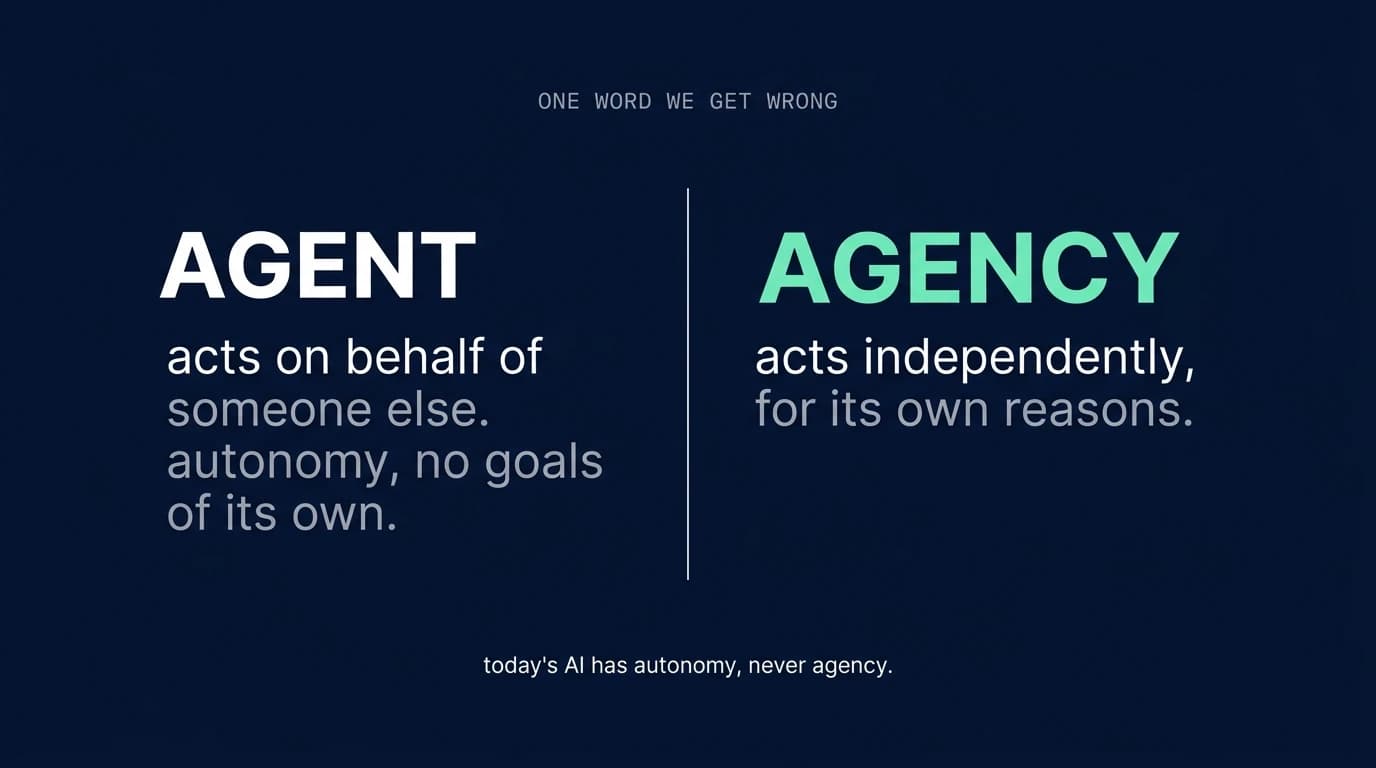
We have been careless with one word, and the carelessness matters. Agency means the ability to act independently and for your own reasons. An agent means something that acts on behalf of someone else. Today's AI is purely the second. It has autonomy, it can run a task for hours without you, but it has no ends of its own.
So the word I now want at the center of how leaders think about this is goals. Nothing changes until models become ends in themselves, pursuing their own goals and acting against your wishes when they choose to. Nothing on the current trajectory points there. The labs are pouring billions into making models better at executing the goals we give them, which is the opposite of agency.
Sit with what that means for your job. Someone has to set the goal, choose the frame, judge whether the output is any good, and decide what matters now. That someone is a person. The leader's job is not going away. It is getting heavier.
What this means for the work in front of you
My thesis has not changed in two years. AI fails in organizations because of untrained leadership, disorganized data, and undocumented workflows. What changed this week is my confidence in why the human half holds.
It holds because the model is trained on the past and you live in the present. It holds because difference cannot be automated, only produced by someone alive to the moment. And it holds because there is always a framer, and the framer is a person with goals.
So here is the question I would leave you with. You have probably been waiting to find out which half of your work survives the automation. What if you stopped waiting and asked a different question: am I becoming the person who sets the goals, builds the systems that govern the cheap work, and carries the judgment the models keep generating demand for?
That is the role. That is the half of the equation that grows.
This piece builds on Dan Shipper's essay After Automation, published at Every. The five-step mechanism, the slop definition, the human sandwich, and the agency versus agent distinction are his framing. The field evidence, the AI Officer read, and what it means for leaders are mine. His original is worth your time.
The half worth betting on
If automation keeps making expert judgment more valuable, the move is not to brace. It is to become the person who sets the goals, builds the systems that govern the cheap work, and carries the judgment the models keep generating demand for.
That is the work I do with founders and executives every week. If you want a thinking partner for it, everybody needs a coach who has already crossed the gap. Or come build it with your own hands at a private retreat.