I'll tell you where today actually started. I caught myself pulling the Blueprint's best wins into my other business instead of the other way around. Part-time builds do that. You ship something that works in one place and your brain quietly migrates it to where your real paycheck lives.
The drift is not a willpower problem. It's the first symptom of the thing I want to talk about today.
The first 80% is not the build
Like any software project, the first 80% felt fast. A week in, I had agents running. Marketing was reporting itself. I had a PM plan on paper. The thing looked like it was working. (Brooks's law, fifty years later, is still the sharpest frame for what happened next.)
Then came the last 20%, and the last 20% has a name. Polish and people.
Polish is the detail you only see when someone else tries to use your system. People is every second human you pull into it. Together they stop feeling like the finishing touch and start feeling like the whole project.
Two humans don't multiply. They negotiate.
Infinite leverage is easiest with exactly one person. Alone, you're the spec, the PM, the reviewer, and the one holding the whole map in your head. You're running at something close to 100%.
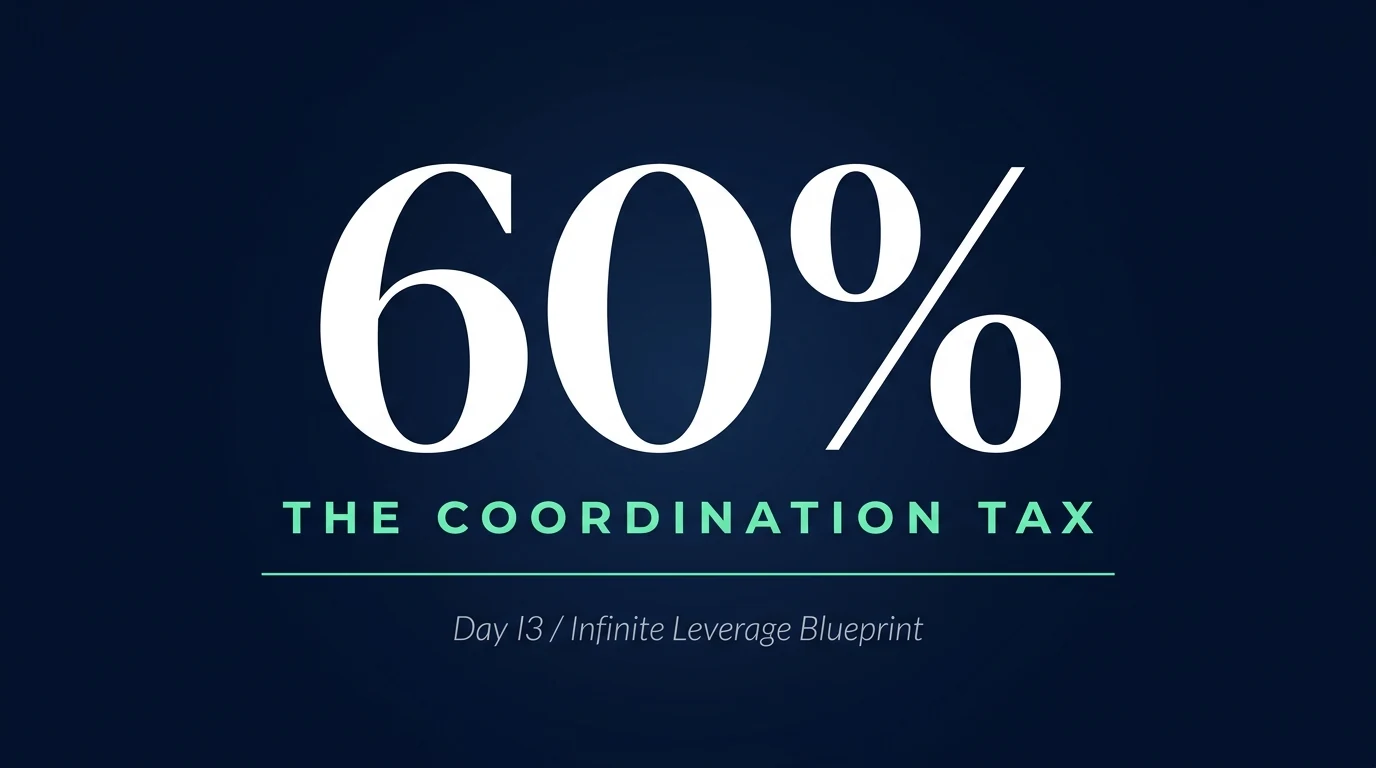
Add a second person and something strange happens. You don't go to 200%. You don't even go to 150%. On a good day, you each drop to about 60% while you figure out how to work together.
Nobody got slower. The work got more expensive to coordinate.
You're checking in and checking out of the same files. You're explaining what you meant in the last stand-up. You're hitting a code conflict someone else didn't see coming. You're teaching a tech-forward but non-coding teammate a whole new language of work: branches, commits, pull requests, what a conflict even is. Every one of those is a skill and a habit, not a click.
Most leadership teams count headcount and assume output scales linearly. It doesn't. Every second person you pull into a build pays a coordination tax until you've built the connective tissue between them.
That tissue is what the Blueprint is really for. Not the agents. The spine that keeps two humans, three agents, and a messy Thursday from cancelling each other out.
What that looks like from the inside
Today the PM agent goes remote, which is a small victory with a big footnote. Claude shipped remote services this week, and that let me move the PM off my laptop without breaking a thing. The marketing team is already running on standup, so every morning I can see what the agents did while I slept. (The agent standup pattern is where we wired that up.)
Here are my new AI teammates, the ones actually running on the Blueprint right now.
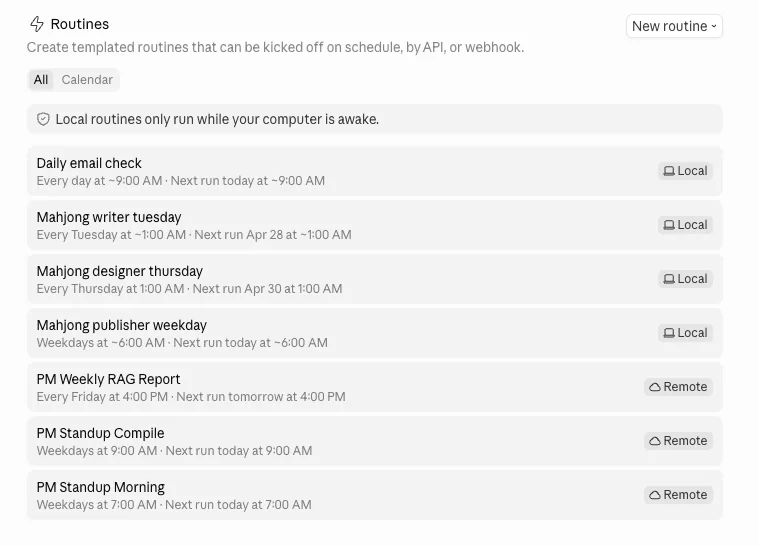
Each row is a job that used to sit on my to-do list. None of them are perfect. All of them are running.
That's the clean half. Here's the messy half.
Yesterday we tried to set up a new person, Eric, on his own Bhutan travel play. The setup was still a bit bumpy. Enough that Trac went back into the setup scripts to work on them again. Because when a new person has to climb a cliff to get into the system, the coordination tax gets paid twice. Once to onboard them. Once to keep them there.
If the setup is hard, the pattern doesn't travel. If the pattern doesn't travel, "infinite leverage" is just a thing that works for me, on my machine, on a good day. That's not a Blueprint. That's a hobby.
One question before Day 14
Tomorrow closes this series. Day 14 is the final piece of the Blueprint, and I'll tell you honestly, I'm going to spend a lot of it on setup, not on new features. (Day 12 was about what to sell. Day 14 is about making sure someone else can install it.)
Before that, a question to sit with today.
No guilt attached to the answer. Sometimes the honest move is to build the connective tissue. Sometimes it's to let one person own the whole thing end to end. Both are right answers. The expensive answer is pretending the tax doesn't exist.
Day 13 of 14
One day left.
Thirteen days in, the system runs, takes money, reports itself every morning, and coordinates a team that is now mostly agents and occasionally human. The part that took actual work this week wasn't the agents. It was the spine between them and the humans trying to use them.
That is the real Blueprint. Not the stack. The connective tissue that lets someone other than me show up on Day 1 and still be productive by Day 3. If that part is missing, nothing scales.
If you want a thinking partner while you build your own version of this, that's what the coaching membership is for. If you want to do it in person with a small group, the Infinite Leverage Retreat is in June. Three days, same questions, across a table.
Read next: Day 12: The Two-Track Business Model · Day 11: The AI Mindset Shift · Day 10: The Coaching Assistant
See you on Day 14.