Drew, TK, and James walk into the office tomorrow morning. The setup is either ready or it isn't. Tonight is the deadline.
This is what Day 13 of the Infinite Leverage Blueprint promised. Day 14 was going to be about setup, not features. The reason matters. After 14 days running this Blueprint on my own machine, the test isn't whether it works for me. It's whether the pattern travels. Tomorrow three founders find out at the same time I do.
What 14 days actually cost
Two full Saturdays. About 100 hours in individual blocks. I was in roughly 50 of them. Trac built the setup script that turns a fresh laptop into a working environment in under an hour. Yon and K2 shipped the Designer and the Outreach Manager. Six months ago that team didn't exist. Today they do, and they are the reason I had time to write this.
Time is the part of this people most underestimate. It takes time to configure. It takes time to teach. It takes time to get unstuck. It takes time to develop the habit.
The honest version is, it took longer than I thought. The more honest version is, it was supposed to.
The habit landed
They say it takes 21 days for something to become a habit. Fourteen was enough for me, after the mindset shift that made it possible.
Here's the new morning ritual. Journal. Read. Move my body. Then one hour of deep thinking on what I want to delegate to the agents that are already running. That hour is the actual product. Everything that ships during the rest of the day is a consequence of how clearly I thought during that hour.
The target is one new agent a day. Even at a 25% hit rate, my team of seven becomes a team of twenty-five by the end of May. That math is the reason I'm calm tonight while three founders are flying in tomorrow.
What's running
The current team. Each of these would cost between $1,000 and $7,000 a month to hire, depending on where in the world you are.
- Writer
- Designer
- Web Developer
- Project Manager
- Product Manager
- Outreach Manager
On deck for the next two weeks:
- Social Media Manager
- Customer Service
- Sales Development Rep
- Bookkeeper
Mahjongtarot.com runs on full automation. Longevity Coach and Forever App are mid-build. A handful of side outputs along the way.
That list looks like the answer. It isn't. The answer is what's underneath them.
Prompt frameworks are dead. Business frameworks are the missing leg of the stool.
For two years the whole industry was hunting the perfect prompt. "Act as a senior X, follow Y framework, output Z format." That whole thing is over. The models got good enough.
What's not over, and what most builders are still missing, is the thinking the agents are supposed to stand on.
My writer thinks she's Dan Shipper at Every. My SEO coach thinks he's Neil Patel. (The em-dashes are finally gone. Life is good.) Beneath that, Georgetown's coaching frameworks driving the coach agent. McDonough School of Business strategy shaping the strategic plan. A growing library of blog styles the writer pulls from.
That's the layer. Without it you have a polite intern with API access. With it, something closer to a senior.
The market is going to spend another year selling prompt courses. The leverage is somewhere else.
Why the setup matters more than the agents
Day 13 hinted at this. Tomorrow it gets tested.
If Drew, TK, and James walk out tomorrow with Git, Vercel, and Supabase configured, with their own writer agent humming, with the habit pattern installed, then this was not a hobby. The pattern travels.
If they walk out frustrated, I have a setup problem to solve, not a model problem.
The skills I had to learn over the last 14 days (Vercel, Supabase, Next.js, .env hygiene, Terminal) already feel routine. Six months ago I'd have hired that out. Now they're vocabulary, not a moat. The gap is no longer technical literacy. It's the willingness to sit with the time it takes.
Where this leaves us
Two years ago, building a team of agents required a research lab. One year ago, it required engineers. Today it requires a habit, the right business frameworks, and a setup that travels. There are zero excuses left.
It is still not easy. You will still hit walls. You will still need an engineer or three for the genuinely hard parts.
But the gap is no longer "can you." The gap is "will you sit with the time it takes."
A question to sit with as the series wraps
Pick one delegation you've been avoiding. The reason you've been avoiding it is probably that teaching it would take a week, and you don't have a week. That's the one your next agent should own. A real business framework and a daily habit, and it pays back inside a month.
If you'd like to work through which delegation to pick, with a small group of leaders running the same Blueprint, the Infinite Leverage Retreat in June is where that conversation lives. Three days, same questions, across a table.
Drew, TK, and James are arriving tomorrow. The retreat in June is the same thing, scaled up.
Day 14 of 14 — Series Finale
Fourteen days in, the system runs, takes money, reports itself every morning, and coordinates a team that is mostly agents and occasionally human. Six roles already running. Four queued. A payroll between ten and seventy thousand dollars a month I am not paying.
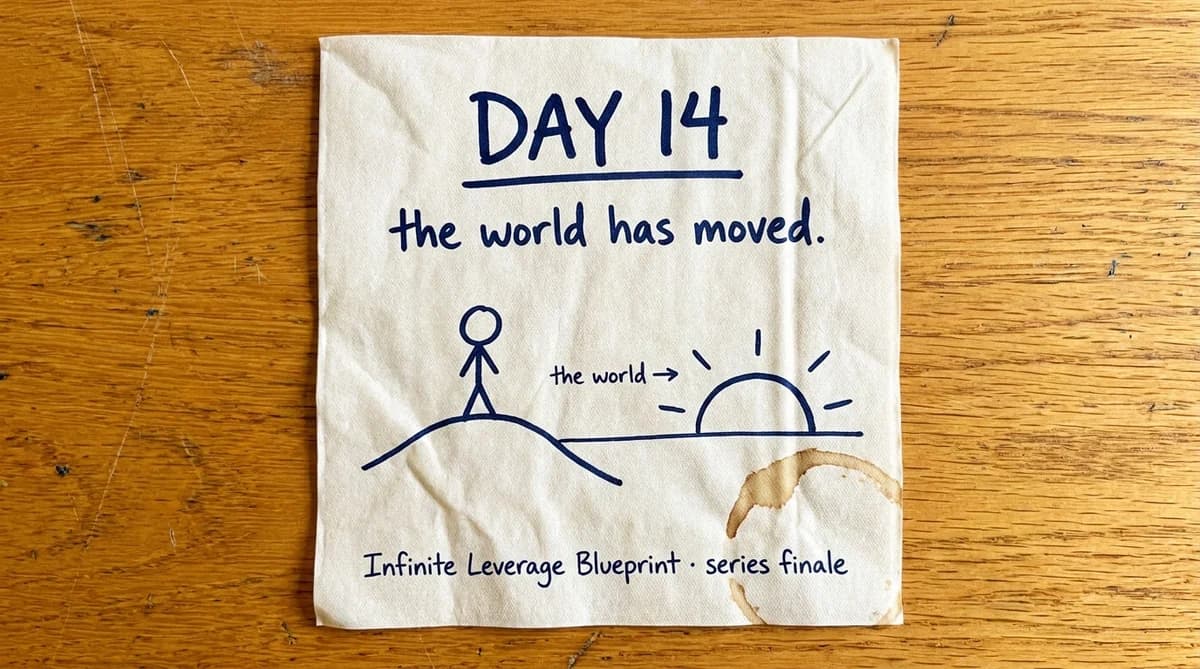
The world has moved. Two years ago this required a research lab. One year ago it required engineers. Today it requires a habit, the right business frameworks, and a setup that travels. There are zero excuses left.
Thank you for following along these last 14 days. The series wraps here.
If you want a thinking partner while you build your own version of this, that's what the coaching membership is for. If you want to do it in person with a small group, the Infinite Leverage Retreat is in June.
Read next: Day 13: The Coordination Tax · Day 12: The Two-Track Business Model · Day 11: The AI Mindset Shift