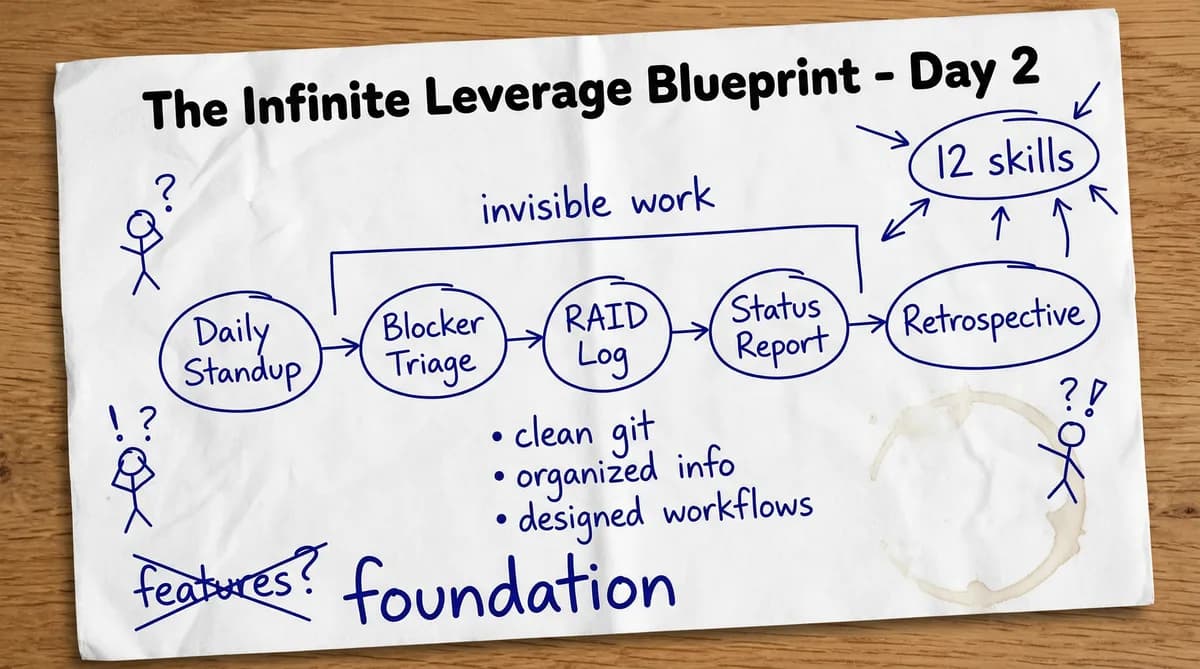
- Daily Standup
- Blocker Triage
- RAID Log
- Release Monitor
- Retrospective
- Scope Change
- Status Report
- Idea to Epic / User Story
- Competitive Analysis
- Build User Persona
- Vision Report
- Solution Options and Recommend
That's 12 agent skills. Not features. Not mockups. Actual, testable agent behaviors -- each one built by combining industry best practice with our own operating flavor, with a visual workflow library showing how they connect and chain together.
Here's what people don't understand about building production-grade AI systems: the agent skills are the visible output. But 80% of the work is invisible.
Problem 01: Scope Constraint
We all have Macs. That's intentional.
We could have spent time making this work across Mac, Windows, and Linux. We could have abstracted everything, documented cross-platform compatibility, solved for every edge case.
We didn't. We decided: for this first founders retreat, we keep it simple. Mac only. If you want to come, bring a Mac -- or borrow one.
This is the unsexy part of execution that nobody talks about: knowing when to add scope and when to cut it. We chose to cut it here. That bought us three hours we could spend on something that actually mattered -- like the agent skills.
One of the best ways to reduce friction is to reduce scope. Not by being lazy -- by being intentional about what problem you're solving for whom. Our first retreat is for founders we know. They have Macs. Done. We can add Windows support later if it actually matters.
Problem 02: Information Architecture
We inherited the Mahjong Tarot website. Beautiful design. But 100+ images with zero organization. Mahjong Tarot is my dad's business. He's an astrologer. The site tells the story of his readings, the cards, the insight.
All the images were mixed together. Readings. Photos of cards. Community moments. The book cover. All unnamed. All unsorted.
Here's the thing: a website isn't just information. It's a story. And the story only works if the images match the content. You need to know which photo is "Dad doing a reading" versus "just a card" versus "community moment." Otherwise the website breaks -- and the narrative breaks with it.
So we spent the afternoon cataloguing. reading_bill for his readings. card_name for cards. community_photo_description for community moments. book_cover_mahjong_mirror for the book. Documented. Organized. Style guide written.
It sounds administrative. It was actually saving the business.
We're using an AI Web Dev Agent to build this site. That agent can't operate if it doesn't know what the pictures are. It needs to understand: is this a reading? Is this a card? Is this my dad in action? Without clear naming and organization, the agent is blind. It can't make decisions about layout, flow, or narrative. Your agents can only be as smart as the data they have access to.
You can see the site we're building here: mahjong-tarot.vercel.app. This is the ABC principle in action -- and it's the same skill we teach in the AI Officer certification.
Problem 03: Workflow Design
One thing people don't realize about multi-agent systems: agents don't work in isolation. They chain together.
Standup
Triage
Log
Report
spective
That's a workflow. And designing a workflow where multiple agents and humans can hand work off to each other -- without dropping it or duplicating effort -- is work.
We had to design: what does a blocker look like when it comes out of Daily Standup? What format does Blocker Triage expect, and what does it output? How does RAID Log consume that output without duplicating what Retrospective owns?
The PM agent's five skills don't work in a vacuum. Idea flows to Epic. Epic informs competitive analysis. Analysis informs personas. Personas inform the vision report. Vision informs solution options. We had to design that chain -- and that took a full afternoon.
The 5 Ds in Practice
At the AI Officer Institute, we teach a framework called the 5 Ds. Every AI officer needs to work through them in order. Day 2 was almost entirely steps 2 and 3 -- and that's exactly where the invisible labor lives.
Get crystal clear on what you're building and why before a single agent is written.
Find where all your information lives, organize it, and catalogue it. Always be cataloguing.
Map how work flows through a system where humans and agents hand off to each other.
Write the agent skills, prompts, and behaviors that make the workflow run.
Ship it. Test it with real people. Learn from what breaks.
Day 2 was steps 2 and 3. Not because we planned it that way. Because that's where the real work was.
The Actual Lesson
Building production-grade AI systems looks nothing like hacking with Claude in a notebook.
The difference isn't the tools. It's the infrastructure.
You can have Claude. You can have good prompts. You can have a strong thesis. But if you don't have clean Git workflows, organized information, and designed agent handoffs -- you have a collection of isolated skills that don't form a system. The boring work is the load-bearing work.
This is why foundation work is brutal on Day 2. Because you're not building features yet. You're building the scaffolding that features depend on. And as we cover in Your Team Needs This Skill, this is exactly what separates AI users from AI leaders: the ability to organize, design, and instruct -- not just prompt.
What's Different Tomorrow
We have clean Git. We have organized information. We have designed workflows. We have 12 agent skills that are testable and chainable.
Tomorrow -- just me and Yon, no engineers -- we don't build new skills. We run the ones we have. We see if the workflows actually hold up with two people instead of four.
That's when we find out if the foundation work was worth it.
The Real Insight
50% of leadership is leading AI. That doesn't mean knowing how to prompt. It means: can you organize information so agents can use it? Can you design workflows so agents can chain together? Can you give clear instructions so agents know what to do?
If yes, your agents scale. If no, you're the bottleneck -- no matter how smart your tools are.
We built this firsthand on Day 2 of the Infinite Leverage Blueprint. The cataloguing, the workflow design, the Git infrastructure -- that's the work that determines whether your agents become force multipliers or just faster mistakes.
Learn how to build and lead AI systems like this at caiocoach.com or explore the full AI Officer certification program.
Read next: Day 3: The System Started Running · Day 1: The Infinite Leverage Blueprint · Your Team Needs This Skill